


Welcome to Autumn 1 in Swifts Class
English
For this half term our main text is The Mermaid of Zennor by Charles Causley.
Our other English work will be linked to our geography work with the aim of creating a non-chronological report about our town.
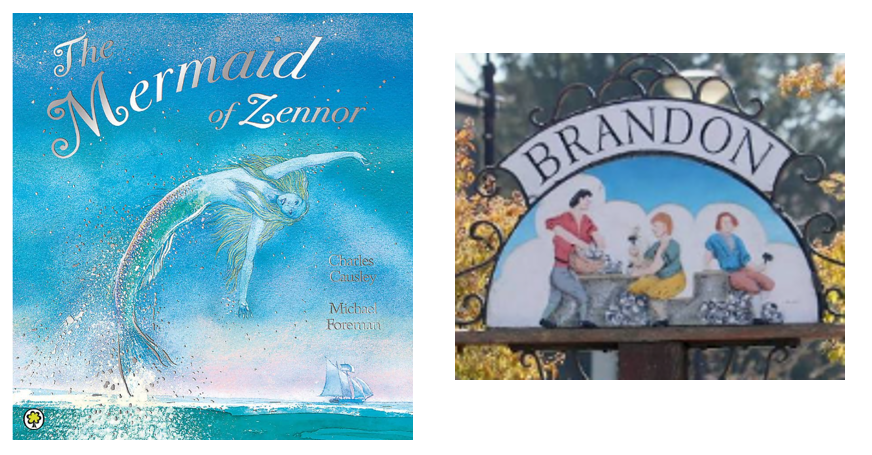
The Mermaid of Zennor: The Mermaid of Zennor is a Cornish folk tale which originates in the village of Zennor. The legend tells the story of a mysterious woman who occasionally attended the parish church of Zennor; a young man followed her home one day, and neither were seen again.
Children begin by exploring the story and language of the book before making predictions and creating some letters to characters in the story. They then go on to create guides to Zennor, retelling the story from the mermaid’s perspective and finishing by creating their own merfolk characters to include in a legend-style story that could be set in Cornwall or elsewhere.
Key grammar covered: Sentence structure, if-then sentences, adjectives, prepositions, possessive apostrophe, homophones, modal verbs, conjunctions, adverbials, verb tense forms, present perfect tense, paragraphing around a theme, direct speech.
Sentence Structure: There are four types of sentence structures: simple, compound, complex, and compound- complex. Using these different types of sentence structures allows variety to be added to writing. A simple sentence is one independent clause with no subordinate clauses.
A useful website: https://www.youtube.com/watch?v=C39_3-M0Nz4
If-then Sentences: In KS2, 'if-then' sentences (also called conditional sentences) use the structure "If + present simple verb, then + future simple verb" to describe a possible event and its likely result. For example, "If it rains tomorrow, then we will stay inside". These sentences can also be written without the word "then", such as "If it rains tomorrow, we will stay inside".
How to build an 'if-then' sentence:
- Start with "If".
- Add a verb in the present simple tense (e.g., rains, is, don't have).
- Add the word "then" (optional).
- Add a verb in the future simple tense (e.g., will get, will stay, will not eat).
Examples for KS2:
- If I do my homework, then I can play video games.
- If the dog barks, then the cat will hide.
- If you don't practice, then you won't get better at it.
- If the party is fun, then we will stay longer.
- If I get a gold star, then I will be happy.
Adjectives: An adjective is a word that describes a noun (the name of a thing or a place).
Useful website: https://www.youtube.com/watch?v=Y10Aa_fhUh8
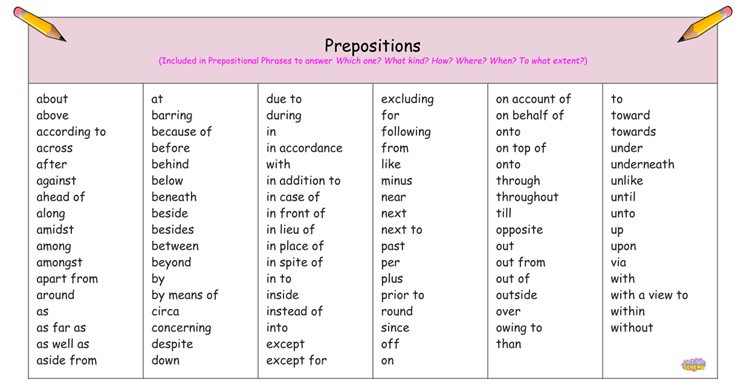
Prepositions: Prepositions are words that show the relationship between a noun, pronoun, or noun phrase and another word in the sentence, typically indicating time, place, or movement. Common prepositions include words like on, under, in, at, before, after, with, and beside. To help identify them, remember they usually come before a noun phrase and can answer questions such as "where?" or "when?
Useful website: https://www.youtube.com/watch?v=vBn_X9VnaoU
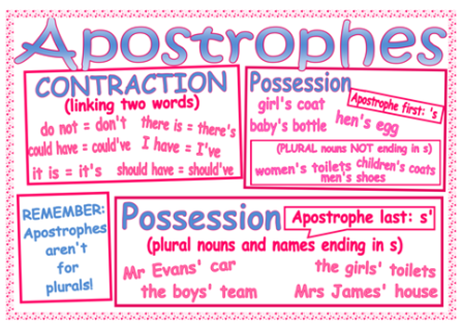
Possessive Apostrophes: Apostrophes can be used to show contraction (For example, cannot = can’t, do not = don’t). We will be focusing on the use of apostrophes to show possession; that something belongs to or is connected to something else. e.g; The girl’s hair was brown.
Useful website: https://www.bbc.co.uk/bitesize/articles/zx9ydxs
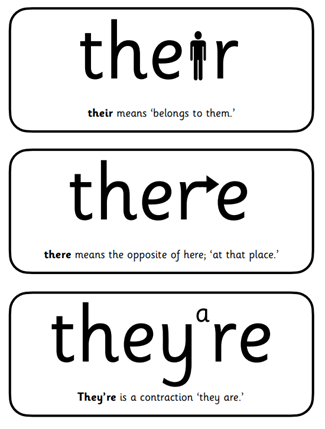
Homophones: Homophones are words that sound the same but have different spellings and meanings, such as there, their, and they're or see and sea. For Key Stage 2 pupils, they are a vital part of spelling, punctuation, and grammar (SPaG) to improve writing. Common examples include hear/here, plain/plane, and knight/night, and learning them involves understanding context and practising their correct usage in sentences.
Useful website: https://www.youtube.com/watch?v=ZubFntFNUGE
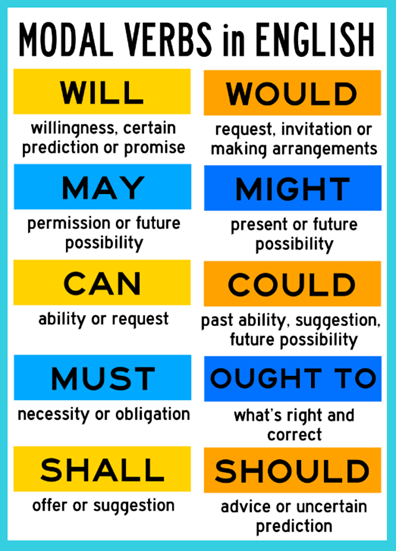
Modal Verbs: Modal verbs are "helping" verbs that add extra meaning to other verbs, indicating possibility, necessity, obligation, or ability. In KS2 English, children learn to identify and use modal verbs like can, could, may, might, must, shall, should, will, and would. These verbs help to express different degrees of certainty, possibility, or obligation in sentences.
A useful website: https://www.youtube.com/watch?v=hbDzdtDXRdQ
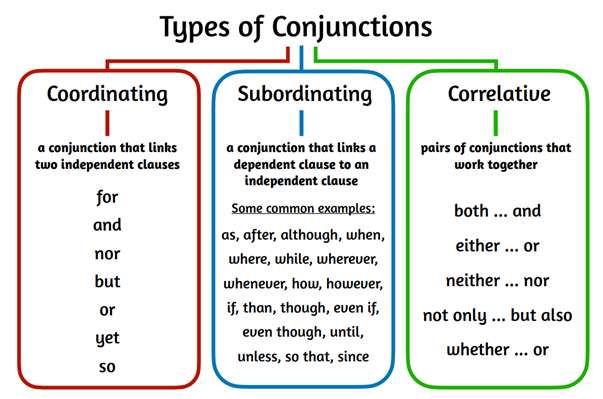
Conjunctions: Conjunctions are words that link clauses and phrases together within a sentence. Examples of conjunctions include 'and', 'but', 'or', 'so', 'yet' and 'for'. In Years 3 and 4, children are taught to use a range of conjunctions to extend sentences. They should be able to use coordinating and subordinating conjunctions fluently in independent writing to help engage the reader.
Useful websites:
(Subordinating conjunctions) https://www.youtube.com/watch?v=e8oYbgH3AZU
(Coordinating conjunctions) https://www.youtube.com/watch?v=lZeByslypsA
Adverbials: An adverbial is a word, phrase or clause which adds more detail or information to a verb, e.g the time, place, or manner of which describes the action in the rest of the sentence.
- He drove to the hospital as quickly as he could.
- The children jumped happily.
- I met my friend in Paris.
- My daughter finished her work at halfpast six.
Useful website: https://www.youtube.com/watch?v=0wy9nfPyExQ
Verb Tense Forms: In Year 4, children continue learning to use the past, present, and future tenses, focusing on understanding and using the present perfect tense (see below) and maintaining consistency within a text. They will also start to recognise how different tenses are appropriate for different text types, such as using past tense for stories and present tense for instructions and explanations.
Useful website: https://www.youtube.com/watch?v=j1CeJ3vp12k
Present Perfect Tense: Children learn the Present Perfect Tense, which uses the auxiliary verbs "have" or "has" with a past participle (e.g., "eaten," "gone," "talked") to describe actions from the past that have a connection to the present. Key uses include talking about recent events ("They have just arrived"), past experiences ("She has been to the shop"), and actions that started in the past and continue now ("He has lived here for two years").
Useful website: https://www.youtube.com/watch?v=yP1aVdexres
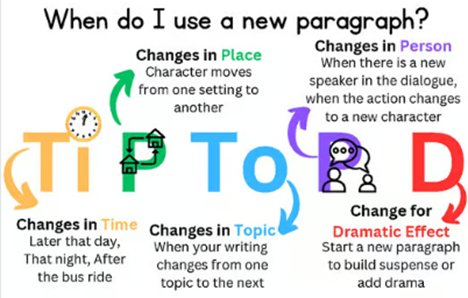
Paragraphing: As a rough guide, we use TiPToP to know where to paragraph within longer pieces of writing.
A useful website: https://www.bbc.co.uk/bitesize/articles/z9n73k7#zj4ms82
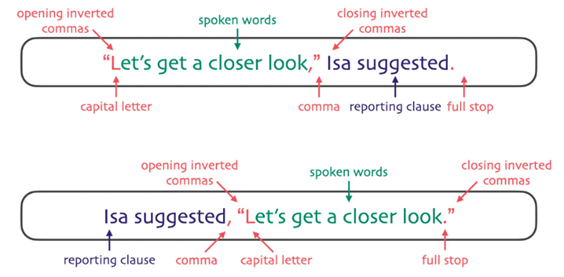
Direct Speech Punctuation: We looked at this during Autumn 2 half Term and pupils were surprised to learn that in order to achieve Age-Related Expectations in their SATs in year 6, pupils must know how to correctly use direct speech punctuation.
Useful website: https://www.bbc.co.uk/bitesize/articles/zhqh92p
Non- Chronological Reports
The purpose of a non-chronological report is to inform its reader about a particular (usually real) subject. They are a type of factual, non-fiction writing which are organised into paragraphs of related content each with its own subheading.
Key Features
- Title and Introduction: A clear heading at the top with an opening paragraph that introduces the main subject.
- Subheadings: Short headings that divide the text into different topics so readers can skim for facts.
- Paragraphs: Sections organized around a single theme, usually written in the present tense and third-person (impersonal language).
- Visuals and Captions: Pictures, diagrams, or maps with short text underneath to explain extra details.
- Technical Vocabulary: Subject-specific words related to the topic (such as science or history terms).
- Grammar Focus: Often includes fronted adverbials (e.g., Beneath the surface, or In addition,) to connect ideas smoothly.
- Conclusion: A final summary paragraph that wraps up the main points.
Spelling
This is taught three times per week and pupils are tested on Mondays. The spelling sheet for each half-term is uploaded to Class Dojo.
Handwriting
This is taught three times per week. It is important that pupils form and place letters correctly and that they develop a cursive, fluent and legible handwriting style. Pupils will receive their pen licence once they can do this consistently.
Mathematics
This half-term, our focus is on place value, addition and subtraction. Pupils make much better progress in all areas of maths if they have fast recall of their number bonds, times tables and related division facts.
Place Value: Teaching will focus on understanding the value of each digit in four-digit numbers and extending this understanding to decimals and fractions later in the year. Pupils learn to identify the number of thousands, hundreds, tens, and ones within a four-digit number, and to read, write, and order these numbers confidently. They also begin to explore rounding and estimation, and make connections between place value and operations like addition, subtraction, multiplication, and division.
Useful website: https://www.youtube.com/watch?v=a3pxaH-dMMc
Addition and Subtraction: Pupils will learn to solve addition and subtraction problems involving numbers up to four digits, using lots of different methods, including using concrete resources, diagrams and formal written methods.
Useful websites:
(Using column methods) https://www.youtube.com/watch?v=NHoRMBVSEfA
(2 step problems) https://www.youtube.com/watch?v=2NLyoC4qvfo
Multiplication Tables Check: Secure knowledge and fast recall of their times tables and related division facts is essential, both for supporting many other areas of mathematical study, but also as an important life skill.
The Multiplication Tables Check (MTC) is a key stage 2 assessment to be taken by pupils at the end of year 4 (in June 2026). The MTC’s purpose is to ensure the times tables knowledge is at the expected level.
It is an online test where the pupils are asked 25 questions on times tables 2 to 12. For every question, you have 6 seconds to answer, and in between the questions, there is a 3-second rest. Questions about the 6, 7, 8, 9, and 12 times tables come up more often. The questions are generated randomly based on the rules of the MTC.
How to prepare: A good way to prepare is to start early and build a daily routine practising the times tables. With regular practice, pupils will learn all the questions and gain confidence. We suggest practising 10 to 15 minutes a day for optimal results.
Useful Website: https://www.timestables.co.uk/multiplication-tables-check/
Art
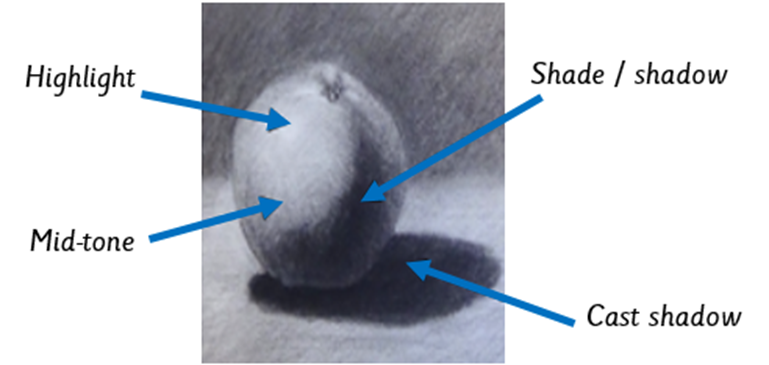
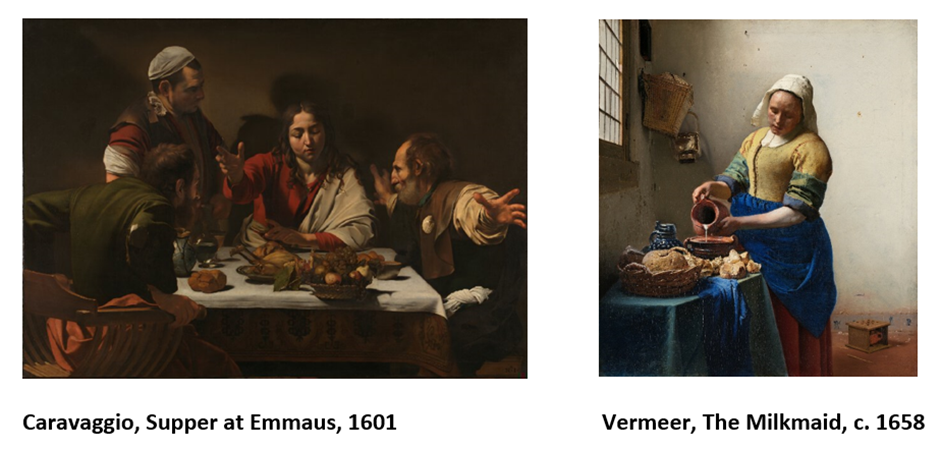
Artists use tone (dark and light) to show the form of an object. Form means the 3d nature of an object. Form is shown by the different ways light falls on an object. Artists use tone to create the illusion that something 2d (a painting or drawing) is 3d.
Artists can also use tone to show drama. Chiaroscuro is an Italian term which means ‘light-dark’ and refers to a technique where an artist uses clear tonal contrasts to create very clear form or dramatic effect
Computing
The internet is a worldwide collection of computer networks. The term ‘internet’ refers to the network infrastructure, not the content stored on it. Web servers store and maintain web content, which is downloaded upon request to computers. Mail servers handle web-based email. Media servers allow clients to stream music and videos. Hosting is the storing of files and data on a web server. The web server is referred to as a host.
Drama
Drama will be used as a strategy to teach and embed across a range of subjects. This will include hot-seating, role-play, conscience ally, freeze-framing, thought tracking, teacher in role, flashback and flashforward questioning.
In addition, we will be auditioning for the Lower Key Stage 2 production! Watch this space!
French Les Saisons (Seasons)
This unit is about learning to listen to French and starting to become more familiar with the different phonics/pronunciation and letter strings/phonemes. Pupils will be starting to learn how to remember and recall words, including conjunctions so that they can say and write at least one short phrase about their favourite season.
By the end of this unit, pupils will be able to:
• Name, recognise and remember all four seasons in French.
• Say which is their favourite season in French and why.
• Start to recognise and use the conjunction ‘et’ (and) in spoken and written responses.
Geography
|
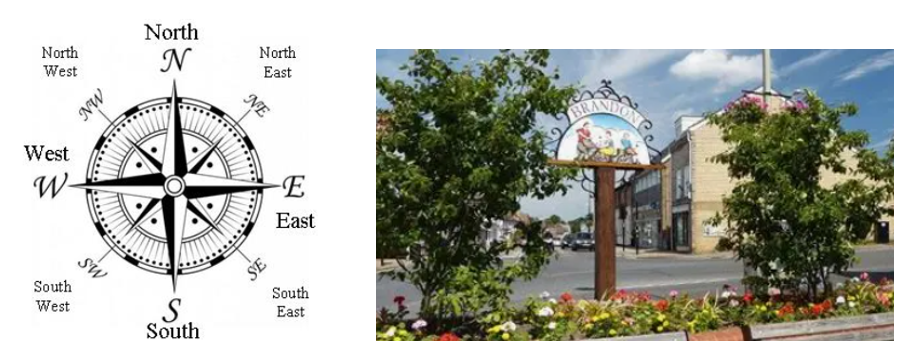
We will learn to name and locate counties and cities of the United Kingdom, geographical regions and their identifying human and physical characteristics. We will explore key topographical features (including hills, mountains, coasts and rivers), and land-use patterns; and understand how some of these aspects have changed over time. Pupils will learn to use the eight points of a compass, four and six-figure grid references, symbols and key (including the use of Ordnance Survey maps) to build their knowledge of the United Kingdom and the wider world. |
We will use maps, atlases, globes and digital/computer mapping to locate countries and describe features studied.
As part of this, we will be putting our geographical skills into practice in our fieldwork. We will be walking a route around our town, following a map, locating points using grid references and identifying places using map symbols.
We will be linking our geographical study to our English work, writing a non-chronological report about our town.
History
Ancient Greece: Greece is a peninsula, which means the Ancient Greeks had easy access to water. Many Greeks lived close to the sea, on islands, near harbours or near rivers. Naturally, many Greeks were explorers and traders. Ancient Greek civilisation, ‘the birthplace of western society’, began around 2500 years ago. The Ancient Greek civilisation emerged after 800 BCE and reached its peak around 330 BCE, with the conquests of Alexander the Great.
Life Skills
Our unit is entitled “How will our feelings grow and change? We all have feelings; they are part of everyone. We feel different things at different times depending on what happens to us. Feelings are a reaction to how your body is feeling. Sometimes we feel sad, like when someone we love goes away. Sometimes we feel happy; like when we are having fun with friends. Part of our work will explore emotional well-being and how to cope with big emotions.
Music
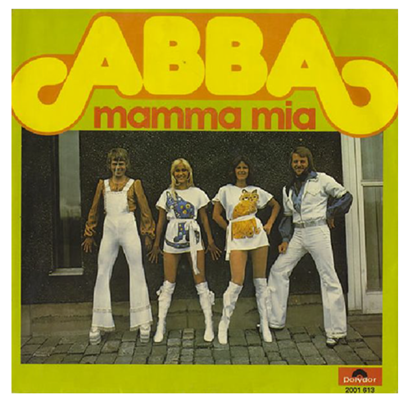
The theme of this unit is based around the music of the hugely successful group Abba, a Swedish pop group formed in 1972. We will be listening to the following songs: Mamma Mia, Dancing Queen, The Winner Takes It All, Waterloo, Super Trouper, Thank You For The Music. We will be singing, playing instruments, improvising and performing.
P.E.
Pupils have two P.E. sessions. Mrs McCaghrey will be teaching gymnastics and Ms Hodges will be teaching the fundamentals of P.E.
Gymnastics: Pupils will develop balancing, rolling, jumping and inverted movements and use these skills to create more complex sequences. Pupils will be taught to demonstrate control in their behaviour to create a safe environment for themselves and others to work in.
Fundamentals of PE: Pupils will develop the fundamental skills of balancing, running, jumping, hopping, skipping, the ability to change direction with balance and control.
They will learn how our bodies move at different speeds as well as how to accelerate and decelerate.
R.E.
Our unit is all about culture and religion.
What is Culture?
Culture can be defined as a pattern of behaviour shared by a group of people or a society. Many different things make up a society's culture, such as food, language, clothing, religion, music, art, customs and beliefs. This usually links to a person’s sense of belonging to a community. Culture can be understood through five key elements:
The Five F’s of Culture
1. Food – What people eat
2. Fashion – How people dress
3. Festivals – Celebrations and traditions
4. Flags – Symbols representing groups or nations
5. Famous Faces – Recognisable figures from different cultures for example, the Royal Family are part of our culture here in Britain.
What is Religion?
A religion is a set of beliefs and practices that help people find meaning in life, understand the world, and feel connected to something bigger than themselves. It often involves worshipping a higher power or God and following rules to live a kind, good life. While there are thousands of religions in the world, they usually share these common things:
Holy Books: Written works, like the Bible or the Quran, that tell stories and give rules for daily living.
Places of Worship: Special buildings, such as churches, temples, or mosques, where people gather to pray and learn.
Traditions & Rituals: Regular patterns of action, such as meditating, singing, or celebrating special holidays throughout the year.
Moral Guidelines: Rules that teach people how to treat others well, like being honest and helpful.
Science
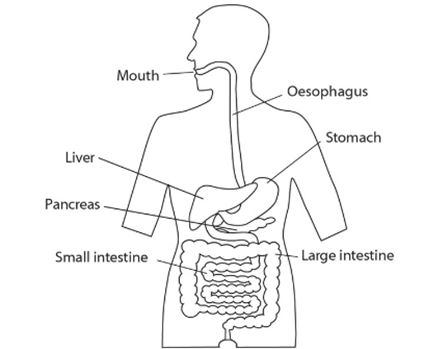
This half-term, science will be taught by Mrs King on Wednesday afternoons. This unit about the human body will focus on the digestive system and include a specific study on our teeth.