
Welcome to Summer 2 in Red Kites Class
English
Our texts for this half-term are Jabberwocky by Lewis Carroll and The Lion, The Witch and the Wardrobe by C S Lewis.
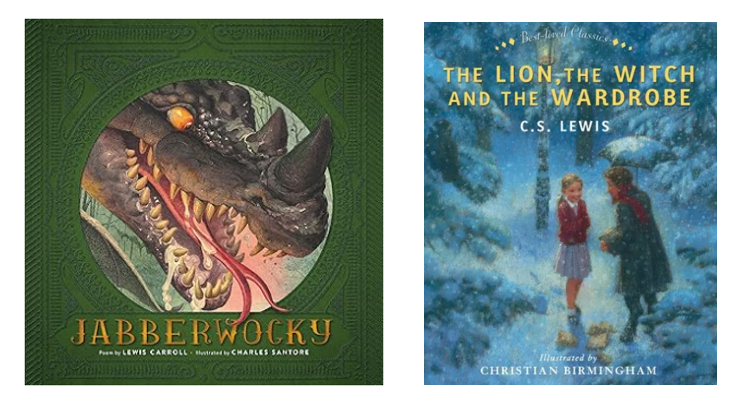
Jabberwocky by Lewis Carroll
"Jabberwocky" is a nonsense poem written by Lewis Carroll about the killing of a creature named "the Jabberwock". It was included in his 1871 novel Through the Looking-Glass, the sequel to Alice's Adventures in Wonderland.
Pupils will use the language of the poem to investigate and explore their knowledge of etymology and morphology, before performing the poem and eventually creating their own nonsense verse with a gruesome creature based on the same structure.
The Lion, The Witch and the Wardrobe
When Peter, Susan, Edmund, and Lucy are sent to stay with a kind Professor who lives in the country, they can hardly imagine the extraordinary adventure that awaits them.
It all begins one rainy summer day when the children explore the Professor's rambling old house. When they come across a room with an old wardrobe in the corner, Lucy immediately opens the door and gets inside it. To her amazement, she suddenly finds herself standing in the clearing of a wood on a winter afternoon, with snowflakes falling through the air. Lucy has found Narnia, a magical land of fauns and centaurs, nymphs and talking animals-and the beautiful but evil White Witch, who has held the country in eternal winter for a hundred years.
Key Grammar We Will Cover:
Key grammar covered will be: prepositions, noun phrases expanded by the addition of modifying adjectives, nouns and prepositional phrases, appropriate choice of pronouns, and nouns within and across sentences to aid cohesion and avoid repetition.
Prepositions: A preposition is a word that tells you where or when something is in relation to something else. Examples of prepositions include words like 'after', 'before', 'on', 'under', 'inside' and 'outside'.
Example: The house was on the hill beside a tree.
In this sentence 'on' and 'beside' are prepositions which show you exactly where the house was.
Useful website: https://www.bbc.co.uk/bitesize/articles/zw38srd
Nouns: A noun is the name of a thing, such as an object, a place, or a person. Nouns are often described as naming words. There are different types of nouns, such as: concrete, abstract, proper and collective.
Useful website: https://www.bbc.co.uk/bitesize/articles/znddqhv#zdttm39
Expanded Noun Phrases: An expanded noun phrase provides more information about the noun in a simple noun phrase. It includes a determiner, the noun and other modifiers, such as a prepositional phrase or adjectives.
Examples:
- I bought a brand-new house.
- I love my old grey dog.
- The teacher cheered for the clever child at the back of the classroom.
Each sentence includes at least one noun and several words that modify that noun as part of the noun phrase. Sentences can also have more than one noun phrase, and noun phrases can even be embedded in other noun phrases.
Useful website: https://www.bbc.co.uk/bitesize/articles/z3nfw6f#zrk6ywx
Pronouns: A pronoun takes the place of a noun in a sentence.
Pronouns are short words like 'it', 'she', 'he', 'you', 'we', 'they', 'us' and 'them'.
They are used to describe either individuals or groups of people, rather than using their name or names.
If we didn't have pronouns, we'd have to keep repeating our nouns and that would make our sentences awkward and repetitive.
For example, if we didn't use pronouns a sentence might look like this:
Tom went upstairs to the bedroom. Tom opened the door and Tom sat on the bed.
Useful website: https://www.bbc.co.uk/bitesize/articles/z37xrwx
Spelling
This is taught three times per week and pupils are tested on Mondays. The spelling sheet for each half term is uploaded to Class Dojo and can also be found here.
Mathematics
This half term, our focus is on time, shape, statistics and position and direction.
Time: Being able to work out differences between times and reading timetables are important life skills. Please support your child be practising reading analogue clocks, calculating using time and becoming familiar with the 24 hour clock format.
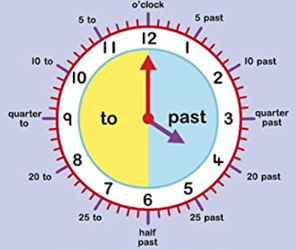
Useful website: https://www.bbc.co.uk/bitesize/topics/zkfycdm
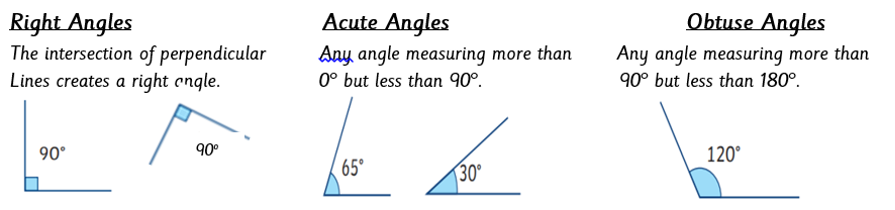
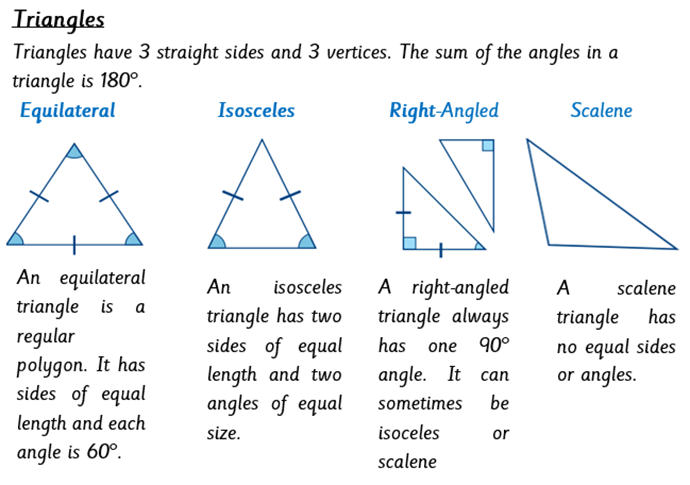
Shape: In our work on shape, we will be focusing on angles, triangles, quadrilaterals and symmetry.
Angles:
Triangles:
Quadriliaterals:
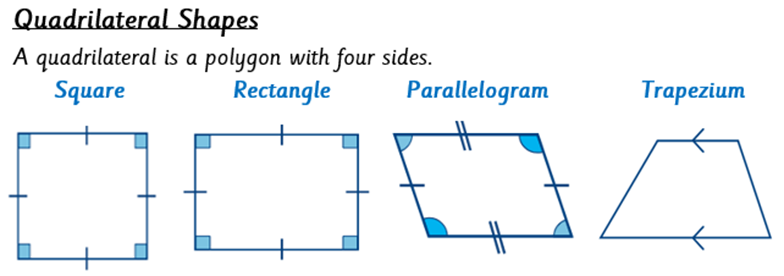
Symmetry: A 2D shape is symmetrical if a line can be drawn through it and either side is a reflection of the other. You would call this the line of symmetry.
If you put a mirror on this line, you would see the whole shape in the reflection. That’s why a line of symmetry is sometimes called the mirror line.
Sometimes you can fold a shape in half, and if it fits into itself perfectly with no overlaps you have found a line of symmetry. Some shapes have more than one line of symmetry.
Useful website: https://www.bbc.co.uk/bitesize/articles/znktm39#zjcsrmn
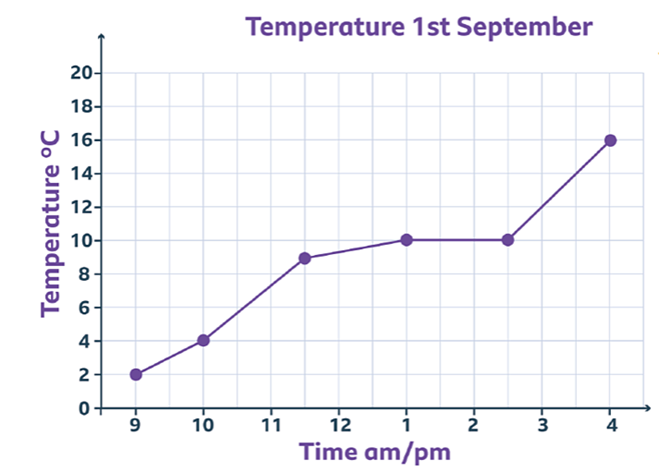
Statistics: We will be learning to read data from charts and to draw and interpret line graphs.
Line Graphs: A line graph is used to represent information which changes over time. A line graph is plotted with points that are joined to create a straight line.
Here is an example:
Useful website: https://www.bbc.co.uk/bitesize/articles/zqv8bqt#zvxr239
Position and Direction:
We will be reading coordinates and learning to plot points on a grid as well as how to descried translation (movement) of positions.
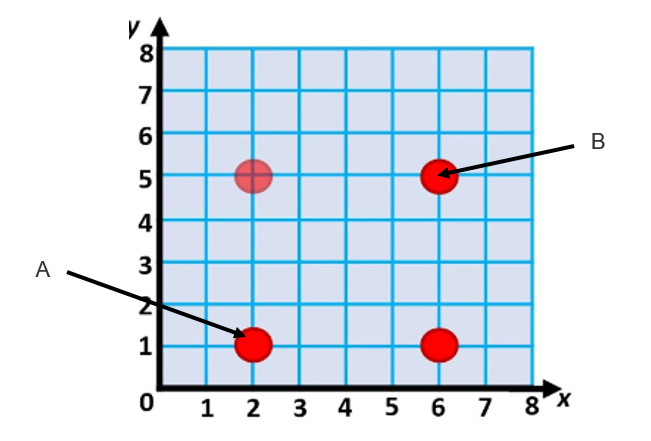
On this grid, the coordinates of point A are (2,1). The x coordinates are always given first.
Point B coordinates are (6,5) We can remember this by saying “Go along the corridor, then up the stairs.”
Useful website: https://www.youtube.com/watch?v=403ydVdMhAM
Multiplication Tables Check: Secure knowledge and fast recall of their timestables and related division is essential, both for supporting many other areas of mathematical study, but also an important life skill.
The Multiplication Tables Check (MTC) is a key stage 2 assessment to be taken by pupils at the end of year 4 in June. The MTC’s purpose is to ensure the times tables knowledge is at the expected level.
It is an online test where the pupils are asked 25 questions on times tables 2 to 12. For every question, pupils have 6 seconds to answer, and in between the questions, there is a 3-second rest. Questions about the 6, 7, 8, 9, and 12 times table come up more often. The questions are generated randomly based on the rules of the MTC.
How to prepare: A good way to prepare is to start early and build a daily routine practising the times tables. With regular practise, pupils will learn all the questions and gain confidence. We suggest practising 10 to 15 minutes a day for optimal results.
Useful Website: https://www.timestables.co.uk/multiplication-tables-check/
D.T:
The Great Bread Bake-Off
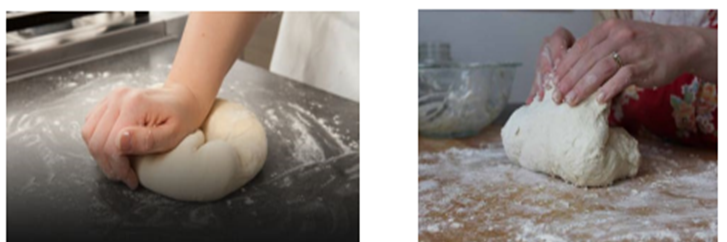
Our DT lessons will include market research into a variety of bread products which will include a tasting and testing session. We will be researching the foundation and expansion of Britain’s biggest bakery business, Warburtons. This unit of work will include learning about the science behind the bread-making process and opportunities to make and bake their own bread
Computing
This lesson will be taught by Ms King on Wednesday afternoons. This term, pupils will be using a program called Scratch to explore repetition in games.
Scratch is a program that we can use in order to code our own stories, animations and games. We can use repeat and loop operator blocks in order to make our programs more logical and efficient. These help to run code continuously or for a set number of times. We use algorithms to sequence movements, actions and sounds in order to program effective animations. In day-to-day life, we use many patterns of repetition. This may include things like; brushing your teeth, performing a dance routine, creating a piece of music, finding a clapping rhythm. It is important to write clear, efficient instructions:
Scratch: https://scratch.mit.edu/
Drama
Drama will be used as a strategy to teach and embed across a range of subjects. This will include hot-seating, role-play, conscience ally, freeze framing, thought tracking, teacher in role, flash back and flash forward questioning.
French
Our unit is all about vegetables and by the end, we will be able to:
• Name, recognise and recall from memory up to 10 vegetables in French.
• Attempt to spell some of these nouns with their plural article/determiner.
• Learn and use the high frequency verb je voudrais from the verb vouloir, to want in French.
We will complete a number of speaking and listening tasks gradually building up knowledge of language in this unit. Activities include completing word searches, word puzzles, matching pair tasks with words and pictures. We will use a range of worksheets that will support the final task of a role-play at a French market stall.

Geography:
Japan is an archipelago, or string of islands, on the eastern edge of Asia. There are four main islands: Hokkaido, Honshu, Shikoku, and Kyushu. There are also nearly 4,000 smaller islands! Japan's nearest mainland neighbours are the Siberian region of Russia in the north and Korea and China farther south.
Almost four-fifths of Japan is covered with mountains. The Japanese Alps run down the centre of the largest island, Honshu. The highest peak is Mount Fuji, a cone-shaped volcano considered sacred by many Japanese.
Japan can be a dangerous place. Three of the tectonic plates that form Earth's crust meet nearby and often move against each other, causing earthquakes. More than a thousand earthquakes hit Japan every year. Japan also has about 200 volcanoes, 60 of which are active.
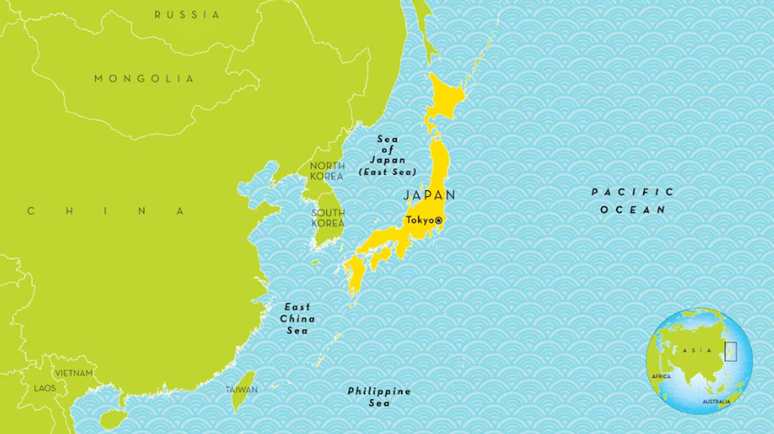
Useful websites: https://kids.nationalgeographic.com/geography/countries/article/japan
History
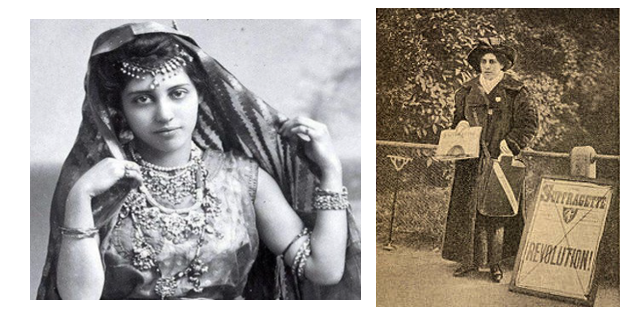
Our local study is all about Sophia Singh. Sophia’s father was the last Maharaja of the Sikh Empire so she was born a princess. British rule in India meant that her family had handed their lands over to the British, and Sophia was born in the UK at Elveden Hall in 1876.
Sophia made history in the early 1900s by risking her royal status to campaign for women's rights. She refused to pay her taxes, took part in rallies and harassed MPs. In 1910, Princess Sophia led a 400-strong demonstration to Parliament with prominent suffragette Emmeline Pankhurst, a protest that became known as "Black Friday". She was often seen selling The Suffragette newspaper outside her home at Hampton Court Palace.
Life Skills
Pupils will be learning about volunteering. Volunteering means giving your time and energy to help others, without expecting anything in return. It’s about giving your time and effort for a cause you believe in. Volunteers are people who give their time and energy to help other people, animals or places without getting any money. Many of our year 4 pupils are currently involved in raising money for the My Wish Charity at West Suffolk Hospital by taking part in the Grow Your Dough Challenge.

Music
This half term, we will be exploring how music connects us to the environment.
Songs in this unit are; You Can See Through It, Octopus Slide and Connect.
P.E.
Tuesday’s PE session, led by Mrs McCaghrey will be OAA (Outdoor Adventurous Activities). Thursday’s PE session will be tennis, led my Ms Hodges. Both sessions will be outdoor lessons, weather permitting.
For all PE sessions, it is essential that pupils have the correct kit, that long hair is tied back and that all jewellery is removed (or earrings taped up).
For our outdoor sessions, pupils should have a pair of trainers or similar (not their school warm shoes) and suitable outdoor clothing. They will not enjoy their PE lessons if they are too hot or too cold.
R.E.
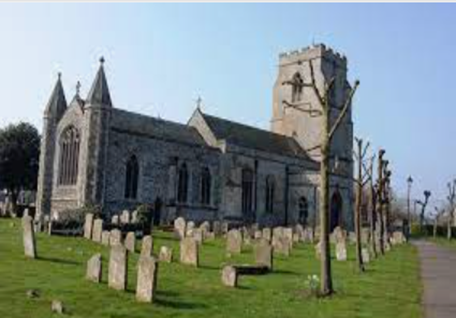
Pupils will be exploring the key question “Do people need to go to church to show they are Christians? This will include a visit to St Peter’s Church.
Science
This lesson will be taught by Ms King on Wednesday afternoons. It this unit, pupils will;
- recognise some common conductors and insulators, and associate metals with being good conductors
- identify common appliances that run on electricity
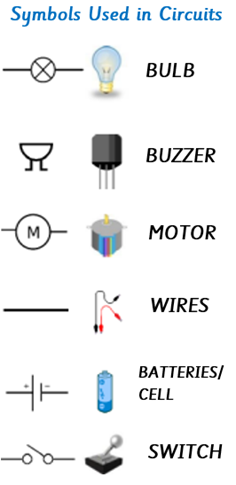
- construct a simple series electrical circuit, identifying and naming its basic parts, including cells, wires, bulbs, switches and buzzers.
- identify whether a lamp will light in a simple series circuit, based on whether or not the lamp is part of a complete loop with a battery.
- recognise that a switch opens and closes a circuit and associate this with whether or not a lamp lights in a simple series circuit.
Useful website: https://www.bbc.co.uk/bitesize/topics/zj44jxs